

Neutrality as Theater
When Anti-DEI Runs Out of Law and Starts Policing Fonts

Author’s Note
This essay is part of an ongoing Justice ReDesigned series examining the legal, economic, and institutional dimensions of Diversity, Equity, and Inclusion (DEI). Each installment addresses a different layer of the debate — from merit and neutrality to profitability and governance — with the aim of separating rhetoric from reality.
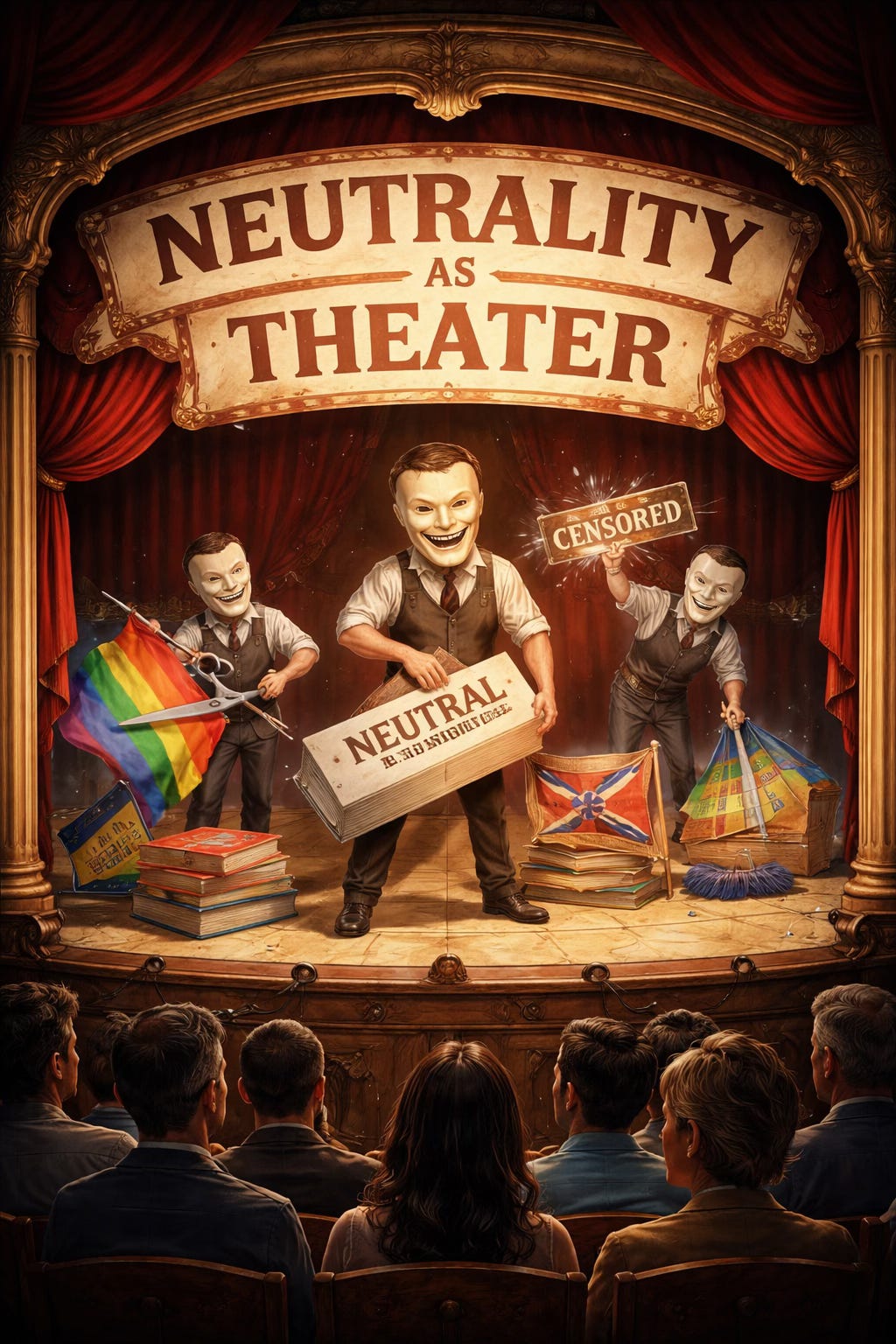
This image was generated by ChatGPT at the author’s request to visually depict the concept of “Neutrality as Theater.” The illustration portrays a theatrical stage where performers wearing exaggerated “neutral” masks engage in symbolic acts of erasure—cutting a rainbow flag, stamping materials as “censored,” and scrubbing historical references—while a diverse audience watches from below. The scene uses satire to illustrate the essay’s thesis: that so-called neutrality is not passive or objective, but an active performance that often conceals selective exclusion.
At some point, every bad idea stops pretending to be serious.
That moment has arrived for the anti-DEI movement.
What began as a legal argument about admissions policy has metastasized into something else entirely—a form of ideological performance art in which “neutrality” is invoked to justify censorship, erasure, and increasingly, absurd micromanagement of public life.
This is no longer about law.
It’s about control dressed up as restraint.
And when a movement reaches the point where it is banning typefaces, scrubbing gift shops, disciplining federal employees for small flags, and litigating to preserve Confederate symbols in schools, it has run out of principle and is operating on inertia alone.
Neutrality has become theater. And the curtain is coming down.
I. When “Neutrality” Stops Being Legal and Starts Being Petty
Let’s begin with the moment that should have ended the debate—if anyone were paying attention.
In 2025, the U.S. Secretary of State’s office became embroiled in controversy not over foreign policy, not over national security, but over a typeface. A font—chosen for accessibility reasons—was deemed suspect because someone decided it “signaled” diversity.
We have now arrived at the point where letters are political.
This is what happens when an ideology loses contact with substance. When you no longer have evidence, doctrine, or outcomes on your side, you start policing symbols. When you can’t defend exclusion on the merits, you start attacking aesthetics.
This is not neutrality.
It is symbolic authoritarianism.
When a government begins regulating fonts, it is not protecting fairness. It is advertising insecurity.
II. Memory Policing Comes to the Gift Shop
The same impulse is playing out in places once thought immune from culture war theater—like national parks.
In multiple states, parks have been ordered to remove books, souvenirs, and educational materials that “promote DEI” from gift shops. Think about that for a moment. We are now purging ideas not from classrooms, but from postcards and pamphlets.
Apparently, history is acceptable only if it fits neatly between a snow globe and a refrigerator magnet.
This is not neutrality.
It is state-mandated amnesia.
When the government decides which versions of history may be sold alongside maps and mugs, it is no longer neutral. It is curating memory. And curated memory is not education—it is propaganda with better packaging.
III. Confederate Nostalgia, Rebranded as Fairness
The same sleight of hand appears in litigation over Confederate school names, where plaintiffs argue that removing names honoring defenders of slavery violates neutrality and fairness.
This is where the logic collapses under its own weight.
The argument is not that these names are educationally valuable.
It is that changing them would be unfair.
Fair to whom?
To descendants of enslaved people forced to attend schools named after their ancestors’ oppressors, or to those who find comfort in historical symbols precisely because they exclude?
Calling this neutrality is like calling a monument to exclusion “heritage”—it only works if you refuse to ask whose heritage is being honored and whose is being erased.
Neutrality, in this context, does not preserve history.
It selects it.
IV. The FBI, a Pride Flag, and the Price of Silence
If all of this still feels abstract, consider the lawsuit filed by a longtime FBI employee who alleges he was fired for displaying a small Pride flag at his workspace—a flag that had previously flown outside an FBI field office with supervisory approval.
Sixteen years of service. Near completion of special agent training.
Dismissed—not for misconduct, not for performance—but for violating a newly aggressive interpretation of “neutrality.”
This is what the Corporate Chill looks like when it enters government.
The message is unmistakable: visibility itself is now suspect. Expression is treated as provocation. Silence is the only safe posture.
Neutrality, once again, is not evenhanded.
It is enforced quiet.
V. When the War on “Wokeness” Reaches the U.S. Mint
And then there is the U.S. Mint.
In one of the more surreal developments of this era, the “war on wokeness” has made its way to coin design. Advisory committees tasked with ensuring historical accuracy and representation were sidelined. Design choices meant to reflect a fuller national story were attacked as ideological.
Even currency—literal legal tender—was not immune.
At this point, the pattern is impossible to miss.
When a movement cannot tolerate diversity in classrooms, workplaces, gift shops, fonts, flags, or coins, it is not defending neutrality. It is defending fragility—the inability to coexist with perspectives it does not control.
VI. The Absurd Endgame of Colorblindness
Taken together, these episodes reveal the endgame of anti-DEI ideology.
It is not colorblindness.
It is context blindness.
It does not elevate standards.
It lowers competence.
It does not unify.
It polices.
And it does not stop at law. It moves next to culture, then language, then memory—until neutrality becomes indistinguishable from erasure.
This is not conservatism.
It is administrative pettiness backed by state power.
VII. Why This Matters — Before We Move Forward
This essay sits where it does in this series for a reason.
In earlier installments, I examined how neutrality, stripped of memory, becomes a tool for preserving inequality. I showed how the rhetoric of fairness can be weaponized to chill inclusion in workplaces and silence context in public institutions.
Here, we see what happens when that rhetoric exhausts itself.
When anti-DEI arguments run out of law, they begin policing symbols. When they cannot win on doctrine, they pivot to aesthetics. When they cannot defend exclusion substantively, they stage neutrality performatively.
But exposing the theater is only half the work.
The deeper question remains:
If “neutrality” is hollow — if it is merely restraint dressed up as principle — then what does responsible institutional design actually require?
What does lawful, performance-driven inclusion look like when it is stripped of optics and built on structure?
In the next essay, I turn from performance to architecture.
Because inclusion, properly understood, is not a preference.
It is a system.
And systems — unlike slogans — can be measured, audited, and improved.
Neutrality that collapses into censorship is fragile.
Inclusion that rests on structure is durable.
That is where we go next.
And remember, neutrality that cannot tolerate history is not neutrality at all.
It is fear—wearing the costume of principle.